
Most "bad tape" complaints aren't actually about the tape — they're about how it was applied. Here are the mistakes that come up again and again.
Mistake 1: Single-strip taping on heavy or export cartons
The most common cause of seam failure. A single strip along the top seam is fine for light parcels, but under real handling stress — stacking, drops, multi-leg transit — it's not enough for anything heavier or export-bound.
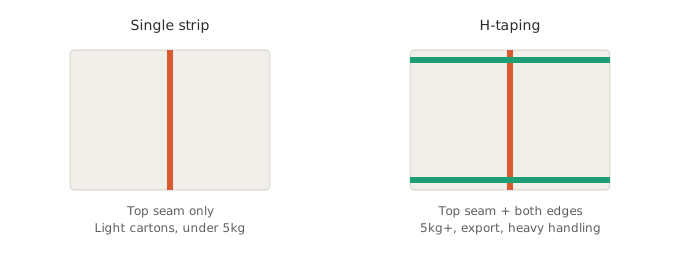
Fix: Use H-taping — the top seam plus both side edges — for any carton over roughly 5kg, and treat it as mandatory for export shipments.
Mistake 2: Taping over dusty, damp, or dirty board
Adhesive needs a clean surface to bond properly. Dust, moisture, or oily residue on the carton surface directly reduces initial tack, regardless of tape quality.
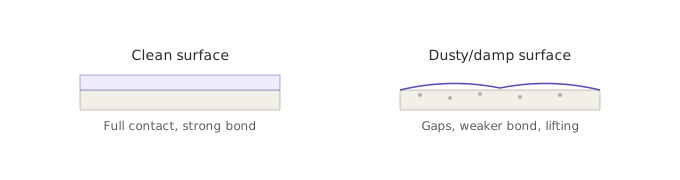
Fix: Wipe down the sealing surface if it's visibly dusty or damp before taping, especially in warehouse environments with high foot/forklift traffic.
Mistake 3: Treating monsoon as an automatic hot-melt switch — or ignoring genuine water exposure
Acrylic handles ordinary monsoon-season ambient humidity fine for the large majority of shipments — switching everything to hot-melt each season overspends. The genuine problem case is direct water exposure: open-truck transit in active rain, or board that's visibly damp/saturated. See the Monsoon Packaging Guide for the full exposure tests.
Fix: Keep water-based acrylic as the default through monsoon; switch to hot-melt only for shipments with direct rain/water exposure or genuinely extended humid storage.
Mistake 4: Under-specifying micron for the actual carton weight
Using a thin, light-duty tape on a heavier carton "because it's cheaper" is a false economy — the cost of a reshipment or damage claim far exceeds the savings on tape.
Fix: Match micron to actual carton weight — see the Micron Guide for a clear breakdown.
Mistake 5: Applying tape at the wrong temperature
Tape applied in very cold conditions (early-morning winter dispatch, unheated storage) can show reduced initial tack — see the North India Winter Guide.

Fix: Where operationally possible, avoid taping in extreme cold, or allow materials to reach a more moderate temperature first.
A real-world example
A packaging supervisor at a mid-size fulfilment operation noticed seal failures spiking every June, assumed a bad batch of tape, and rejected two supplier shipments before realizing the pattern correlated with monsoon onset, not the tape itself. The board they used was partially recycled content, which absorbed ambient humidity faster than expected. The genuine trigger was the visibly damp, saturated recycled board — switching those specific damp-board lots to hot-melt (see the Monsoon Guide) resolved it, while the rest of their volume stayed on standard acrylic — no supplier change and no blanket seasonal switch needed.
FAQ
How do I know if a sealing failure is a tape problem or an application problem? Check the pattern: if failures cluster around specific operators, specific times of day, or specific carton types, it's more likely application/technique. If failures are spread evenly and correlate with season or board source, it points toward an adhesive-conditions mismatch.
Is it ever correct to use three or more strips of tape on one carton? Yes, for genuinely heavy or high-risk cartons (well above standard H-taping weight ranges) — extra reinforcement strips at stress points are a reasonable escalation beyond standard H-taping, not overkill.
Can old or expired tape cause sealing failures? Yes — see the Storage & Shelf Life guide for how storage conditions and time gradually affect performance, which can look identical to a fresh-batch quality issue if the storage history isn't known.
What's the fastest way to diagnose a sudden spike in sealing complaints? Check for a recent change first — season, board supplier, staff, or storage conditions — before assuming a tape defect. Most sudden spikes trace back to something that changed on the operational side, not a manufacturing inconsistency.
Seeing a recurring sealing issue that isn't covered here? Talk to PackGPT and describe what's happening — it's often a quick diagnosis.